
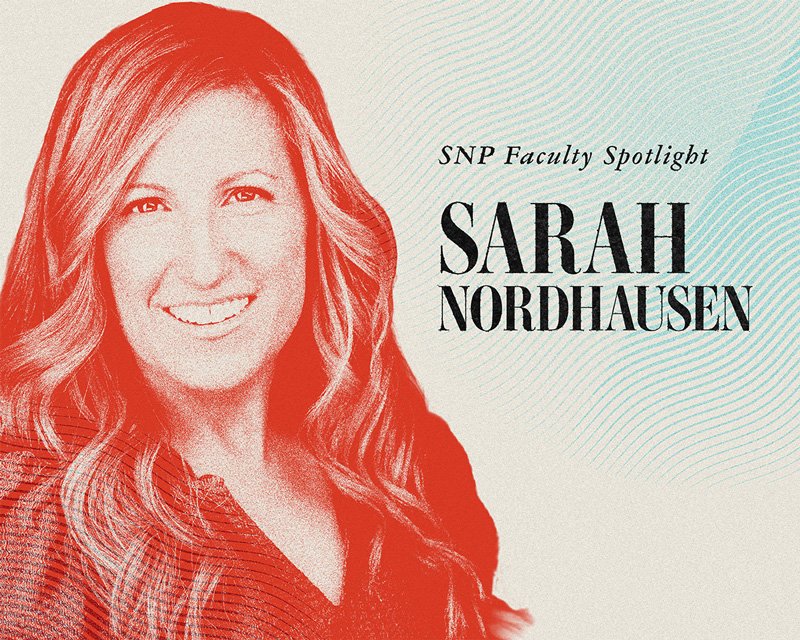
SNP faculty help leaders see their potential and step into it with clarity and courage. In this Faculty Spotlight, we sat down with Sarah Nordhausen, a people-first coach whose work blends empathy, systems thinking, and a deep belief in human potential. Sarah explains the mirror-and-kaleidescope role of coaching, the critical leadership trait leaders must have before they start working with a coach, and why she describes her work as “wildly fulfilling.”
SNP: You moved from social work and education to coaching…tell us about that path.
Sarah: I’ve always gravitated toward meeting people where they are and thinking in systems—how we’re all interconnected. When I moved into an HR/people leadership role at a school, I had my first coach, and it was life-changing. I also realized that the part of the work I loved most was helping incredible educators see their own potential. When my family began moving every few years for my husband’s military career, a friend gave me the best advice: find work not tied to geography. Coaching was phone- and video-based long before it was common. It fit perfectly. I went back, trained, certified, and have been coaching ever since. It’s wildly fulfilling.
SNP: You’ve said you help people “see their potential even before they reach it.” What does that look like in practice?
Sarah: As a coach, I sit in a very privileged place. I get to see someone without the filters of their inner critic. My role is to mirror back what I see—and also offer new angles, like a kaleidoscope. Both images matter: the mirror for clarity, the kaleidoscope for perspective. When people feel truly seen and supported, they step into their strengths with more courage and more clarity. That’s the part of coaching I love most.
SNP: And you gravitate toward coaching people managers specifically…why?
Sarah: That’s where the greatest impact lives. “People first” isn’t a cliché—it’s the core of organizational health. And the best way to invest in people is through the leaders who support them. I love helping managers uncover their “backbone and heart”—the balance of accountability, clarity, and boundaries with empathy, compassion, and curiosity. Both are necessary. And when leaders shift, the ripple effect throughout their team and organization is enormous.
SNP: In our conversation, you’re using “leader” and “manager” interchangeably. How do you think about the difference?
Sarah: They are different—but connected. To me, a leader is anyone who can see potential in someone and help them reach it. At their best, that’s exactly what great managers do. “Leader” is the purpose. “Manager” is simply the bucket we’ve labeled it.
SNP: For someone considering working with a coach, what’s something they need to know?
Sarah: Coaching takes courage. It asks you to be vulnerable. It’s the coach’s responsibility to build trust, and create a psychologically safe environment. The leader needs to show up with courage. So if the timing, capacity, and willingness are there, the needle moves. If timing, capacity, and willingness are not there yet, that’s okay. Coaching works when the person is ready.
Sarah’s coaching style blends clarity with compassion, helping leaders see themselves honestly while also widening their perspective. She creates a space that’s grounded, psychologically safe, and appropriately challenging. Leaders and people managers build both confidence and capability.
Click here to learn more about coaching with SNP Communications.